
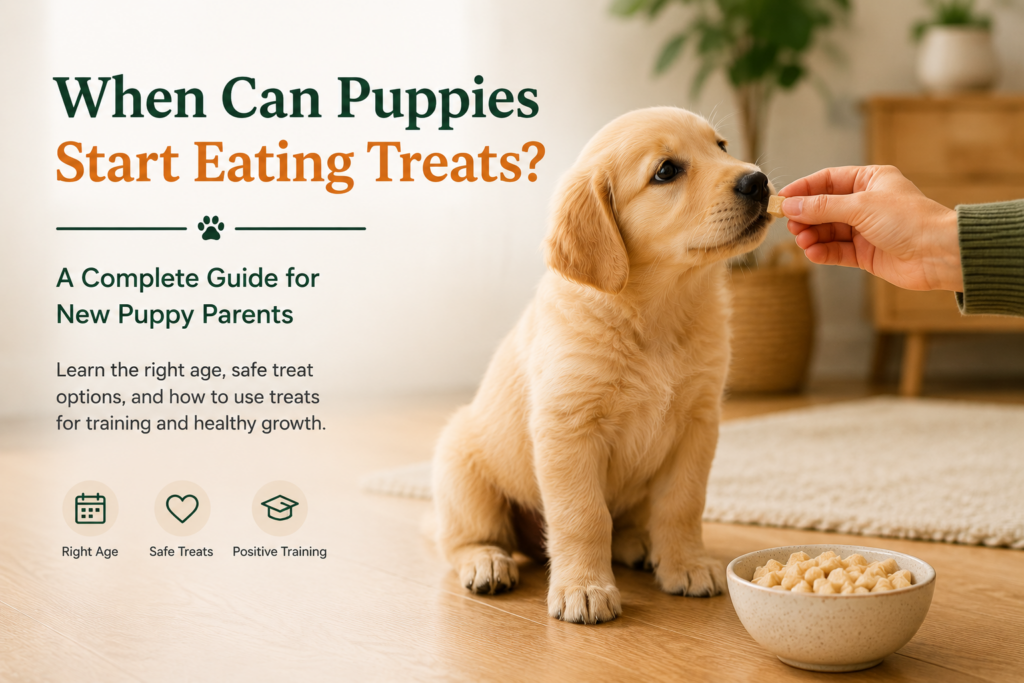
Treats are one of the first bonding tools most new puppy owners reach for — they’re useful for training, comforting, and just showing love. But puppies aren’t small adult dogs, and giving the wrong treat at the wrong age can cause more harm than the enjoyment is worth.
This guide covers exactly when puppies are ready for their first treats, which textures and sizes are safe at each stage, and how to use treats effectively without upsetting a still-developing digestive system.
Key Takeaways
- Most puppies can start having treats from around 8 weeks, once they’re confidently eating solid puppy food.
- Readiness matters more than a fixed age — a puppy still adjusting to weaning isn’t ready.
- Soft, single-ingredient treats are the safest starting point.
- Treats should never exceed 10% of a puppy’s daily calorie intake.
- Introduce one new treat at a time, watching for reaction over several days.
🐾 Quick Tip If your puppy is eating its regular puppy food well and showing no digestive upset, it’s typically ready for its very first small, soft treat.
Why Timing Matters for Puppy Treats
A puppy’s digestive system is still developing well into its first year. Enzyme production, gut bacteria balance and the ability to process anything beyond a simple diet are all still maturing. Introducing treats too early, or introducing too many textures and ingredients too quickly, is one of the more common causes of unexplained puppy tummy upset.
Timing isn’t only about digestion — it also connects to training. The socialisation window (roughly 3 to 14 weeks) is when puppies form lasting associations fastest, which makes correctly timed, safe treats a genuinely useful training tool rather than just an indulgence.
When Can Puppies Start Having Treats?
As a general guide, puppies can begin having small treats from around 8 weeks old, once they’re already eating solid puppy food comfortably — not before. A puppy still transitioning off milk or still hesitant with solid food is not ready for anything additional yet.
Every puppy develops at a slightly different pace. The better indicator than a fixed age is whether your puppy is:
- Eating its regular meals with no hesitation
- Showing normal, well-formed stools
- Free of any known digestive sensitivity flagged by your vet
If all three are true, a small, soft, single-ingredient treat is generally a safe starting point.
Choosing Age-Appropriate Treats
Texture and size both matter more for puppies than for adult dogs, since a puppy’s adult teeth typically aren’t fully in until 4–7 months.
| Puppy Age | Recommended Treat Texture | Notes |
|---|---|---|
| 8–12 weeks | Very soft, small, single-ingredient | Break into tiny pieces; supervise closely |
| 3–6 months | Soft to lightly firm | Teething period — avoid very hard textures |
| 6–12 months | Firmer textures introduced gradually | Adult teeth mostly in; still avoid extremely hard chews |
Single-ingredient treats remain one of the safest choices at every stage, since there’s no ambiguity about what your puppy is reacting to if something doesn’t agree with them. Our guide Are Single-Ingredient Dog Treats Better? Everything Pet Parents Need to Know breaks this down further.
Kuku Bites™ are freeze-dried 100% chicken breast that soften quickly and can be broken into very small pieces — a texture that works well from the early treat stage onward. For more on why freeze-dried textures suit younger and older dogs alike, see our Freeze-Dried Dog Treats Kenya | Complete Buying Guide.
How Many Treats Can a Puppy Have?
The same 10% rule that applies to adult dogs applies to puppies: treats should make up no more than 10% of total daily calorie intake, with the remaining 90% coming from a complete, balanced puppy food. For a full breakdown of meal frequency and portion sizing by age, see our companion piece, the Puppy Feeding Guide: What to Feed, How Much, and How Often.
Puppies have a smaller calorie budget than adult dogs relative to how quickly treat calories can add up, so a “small handful” that looks harmless can represent a larger share of the day than it would for an adult dog of the same breed.
Treats to Avoid for Puppies
- Hard bones, antlers or very hard chews — risk of damaging developing teeth
- Rawhide — choking and digestive blockage risk, especially for small mouths
- Human food scraps — many common ingredients (onion, garlic, chocolate, grapes) are toxic to dogs
- Salted or seasoned broths — puppies are especially sensitive to excess sodium
- Anything with artificial colours or flavours — unnecessary for a puppy’s developing palate and adds no nutritional value
Using Treats for Early Training
The 3–14 week socialisation window is the most efficient time to build positive associations — with people, new environments, sounds, and basic cues like their name. Timing matters here too: reward within 1–2 seconds of the desired behaviour so your puppy connects the treat to the action, not to whatever they’re doing a few seconds later.
Keep training treats tiny during this stage — a piece the size of a small pea is usually enough to register as a reward without adding meaningful calories across a session.
Introducing a New Treat Safely
Whenever you introduce a treat your puppy hasn’t had before:
- Offer a small amount and wait 24–48 hours before introducing anything else new.
- Watch for any change in stool consistency, itching, or unusual lethargy.
- If no reaction occurs, the treat can be added to your puppy’s regular rotation.
This one-at-a-time approach means that if a reaction ever does occur, you’ll know exactly what caused it.
Frequently Asked Questions
What age can puppies start eating treats? Most puppies can start having small, soft treats from around 8 weeks old, once they’re confidently eating solid puppy food.
Can 8-week-old puppies have chicken treats? Yes, as long as the treat is soft, single-ingredient, and broken into very small pieces appropriate for a young puppy’s mouth.
How many treats should a puppy have per day? Treats should make up no more than 10% of a puppy’s total daily calorie intake, with the rest coming from a complete and balanced puppy food.
Are freeze-dried treats safe for puppies? Yes. Freeze-dried treats like Kuku Bites™ soften quickly and can be broken into small pieces, making them a suitable texture for puppies once they’re ready for treats.
Can puppies choke on treats? Any treat given in a piece too large for your puppy’s mouth carries a choking risk. Always size treats to your puppy’s current mouth and supervise treat time closely.